


L’Annonciation (The Annunciation)
The Work
- Title: L’Annonciation (The Annunciation)
- Artist: Floris Jespers
- Date: 1938-1940 (signed l.r. 1940)
- Technique: Oil on canvas
- Dimensions: 210 x 190 cm
In Essence
“The Annunciation“, considered by Floris Jespers himself as his most important work, is one of the most layered masterpieces in Belgian art. Jespers consciously enters into a dialogue with the 500-year-old tradition of the Flemish Primitives, but gives it a radically modern and personal twist. It is not only a painting of the Annunciation, but a profound reflection on the act of painting itself, and it forms the indispensable key to his entire oeuvre.
A Deeper Look
A Dialogue with the Masters: The Flemish Primitives Revisited
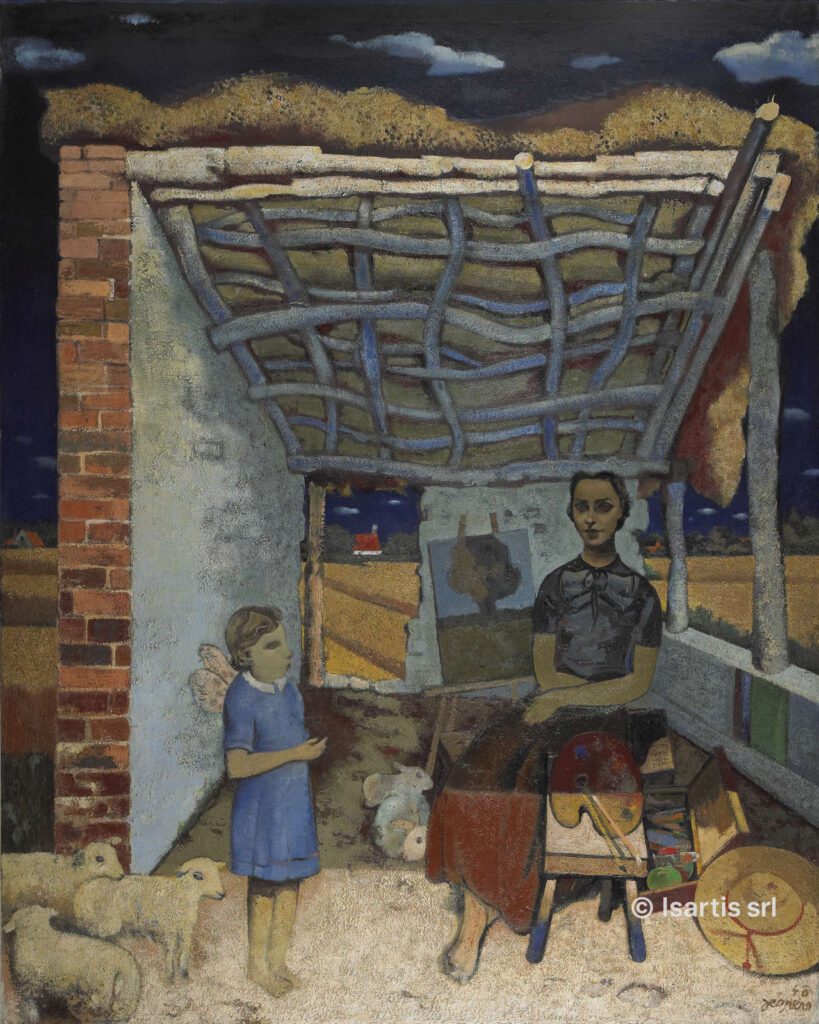
The core of this work is a technique as old as Flemish painting itself: the sacred story is lifted from its historical context and placed in one's own, recognisable world. Just as Jan van Eyck situated the Annunciation in a 15th-century interior, Jespers places it in a poor, contemporary Flemish stable. The angel is a village girl in bare feet, Mary a pensive, stilled woman. The intention, however, is fundamentally different. Where the Primitives sought devotional realism, Jespers seeks expressionistic expression and modernist self-reflectionThe ultimate proof of this is the prominently depicted painter's easel. Jespers shows us not only the scene, but also the artist creating it, thus posing the question of how a modern painter can relate to the great, centuries-old tradition.
A Web of Symbols: Old and New Covenant
Within this modernist framework, Jespers weaves a rich tapestry of profound symbolism.
- The sheep the angel brings are a direct reference to the Lamb of God (Agnus Dei), a foreshadowing of the sacrifice of Christ.
- On the easel, an oak tree is painted, a reference to the Oak of Mamre, the site of the first covenant between God and man in the Old Testament.
- The foot of Mary, which she consciously places in the divine light in the foreground, symbolises her active "yes" to the message, and the start of the New Covenant.
The Turning Point: A Bridge to the Future
"L'Annonciation" is more than a masterpiece, it is the indispensable link that connects Jespers' early and late work. His famous Congolese period was not a radical break, but the logical continuation of the search that began here.The focus on an 'earthly spirituality', the 'primitive' aesthetic, and the stylised, monumental figures are precisely the elements he would perfect in Africa in a new, powerful visual language. This work proves that Jespers' quest for the 'essential' and authentic was already fully developed in the Flemish clay, long before his journeys to the south. The presence of this painting at the 'Kongo - Knokke' exhibition (2015) objectively confirms this crucial bridging function.
An Acclaimed Masterpiece
Major Exhibitions
- 1942: Kunstverbond, Antwerp
- 1966: Galerie Campo, Antwerp
- 1967: Provincial Beguinage, Hasselt
- 1989: Royal Museum of Fine Arts, Antwerp
- 1990: Singer Museum, Laren (The Netherlands)
- 1990: Castle of Gaasbeek, Gaasbeek
- 2004: PMMK (Mu.ZEE), Ostend
- 2015: CC Scharpoord, Knokke-Heist
Published in
- Burssens, G. (1943). Floris Jespers.
- Jespers, H.F., et al. (1966) Floris Jespers.
- Retrospective Floris Jespers (1967).
- Buyck, J., & Schoeters, G. (1989). Floris Jespers, Retrospective exhibition.
- Buyck, J. (2004). Floris Jespers.
- Vanwijnsberghe, S. (2015). Floris Jespers Afrikanist: Kongo-Knocke.