


Marc groet 's morgens de dingen (Marc greets the things in the morning)
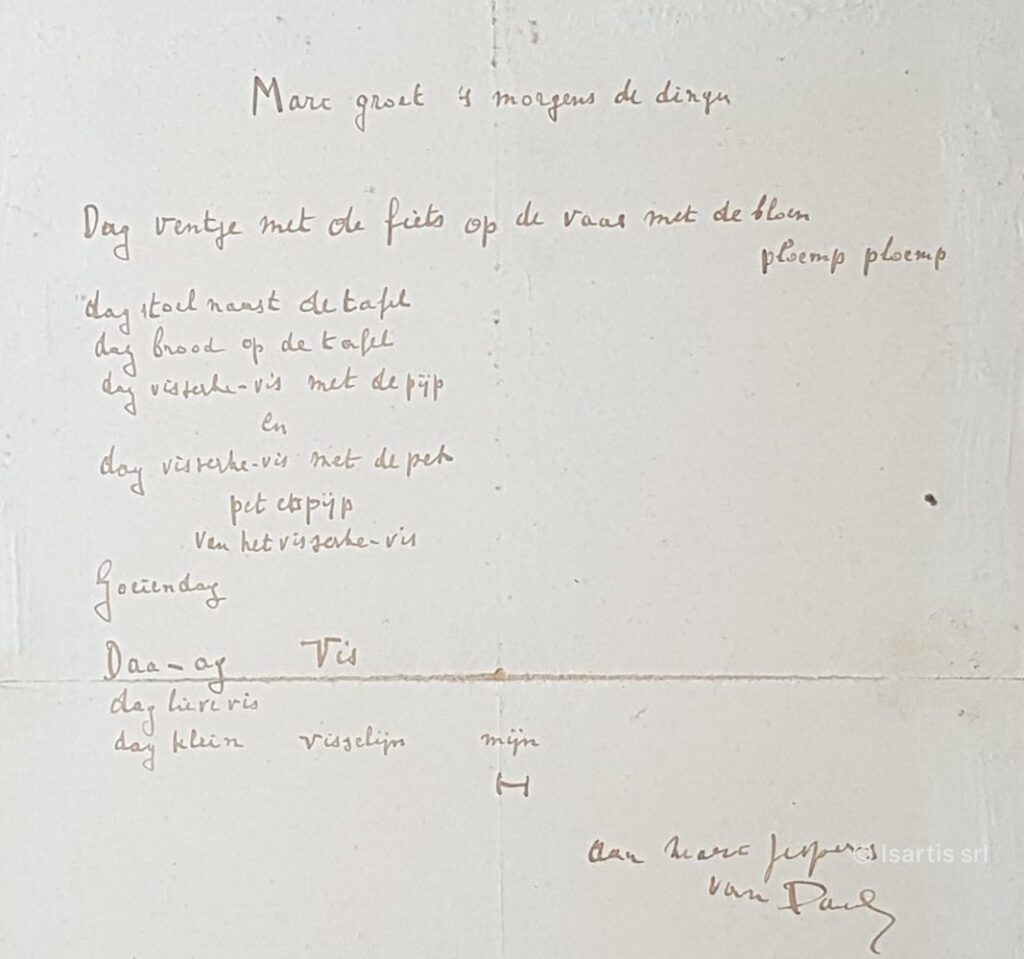
The Work
- Title: Marc groet 's morgens de dingen
- Artist: Paul Van Ostaijen
- Date: 1924
- Technique: Ink on paper
- Dimensions: [Dimensions not available]
In Essence
This handwritten manuscript is cultural relic of inestimable value and one of the most moving documents in the collection. It is the most tangible evidence of the deep friendship between poet Paul van Ostaijen and Floris Jespers, the two engines of the Antwerp avant-garde. The personal dedication to Jespers' son Marc makes this iconic poem, which exists here in its definitive form as dedicated by the poet , a unique and deeply personal gift.
A Deeper Look
A Visual Poem
This is not an ordinary text, but a textbook example of modernist poetry, where form and content perfectly coincide. The words "dance" across the page in what Van Ostaijen called "rhythmic typography" . The playful, non-linear composition reflects the free, associative thought process of the child greeting the world. The poem is meant not only to be read, but also to be seen; it is a work of art in itself.
From Manuscript to Public Domain
This manuscript, written in the second half of 1924, represents the beautiful fair copy that Van Ostaijen prepared as an intimate gift . It is the version in which the poet definitively changed the original title, 'Berceuse no. 2', to the iconic name 'Marc groet 's morgens de dingen', as a direct and personal ode to his friend's son. A letter from Floris Jespers from late 1924 confirms that he had already received the text in manuscript form for his son. The very first public printing followed months later, in April 1925in the magazine De Driehoek. This manuscript is therefore not a copy, but an exclusive document that circulated in the intimate circle of friends before it became world-famous.
The Link in the Life Story
Within the collection, this manuscript functions as a crucial link connecting several masterpieces. It forms an exceptionally moving diptych with Jespers' "Last drawing". Where Van Ostaijen's poem describes the childlike gaze that brings the world to life (in the morning), Jespers' final work depicts the serene farewell gaze of the old master (in the evening). It forms the alpha and the omega of a life story.
From Word to Image: The Enduring Inspiration
The inspiration was so direct that Floris Jespers created his own masterpiece as an artistic response as early as 1925-1926, shortly after the poem's publication: an oil painting with the same title (today in the collection of the Phoebus Foundation). This proves the exceptional, real-time interaction between the poet and the painter and shows how this manuscript was an immediate source of artistic inspiration .
A Unique Cultural Heritage
Status
As a unique, dedicated manuscript of one of the most beloved poems in Dutch literature, this is an object of the highest heritage category. The combination of literary value (Paul van Ostaijen) and art-historical connection (Floris and Marc Jespers) makes it an irreplaceable document. The clear signs of wear on the fold lines testify to a history of intensive and cherished possession; this is not an archive piece that has lain flat for decades, but a relic that was probably carried around for years before being framed, an act that explains the slight discoloration of the ink.