


Perspectives
on
Jespers’
Art
The versatility of Floris Jespers is legendary, but beneath the changing styles lies a remarkably coherent artistic signature. His work is a constant dialogue between the language of the artist —his unique mastery of line, colour, and form—and the way that art was interwoven with his life,his friendships, and the world. These perspectives invite a deeper look into the mastery of one of Flanders' most fascinating modernists.
The Language of the Artist: Style and Technique
Stijl en Techniek
The Line as Power: Mastery in Expressionism
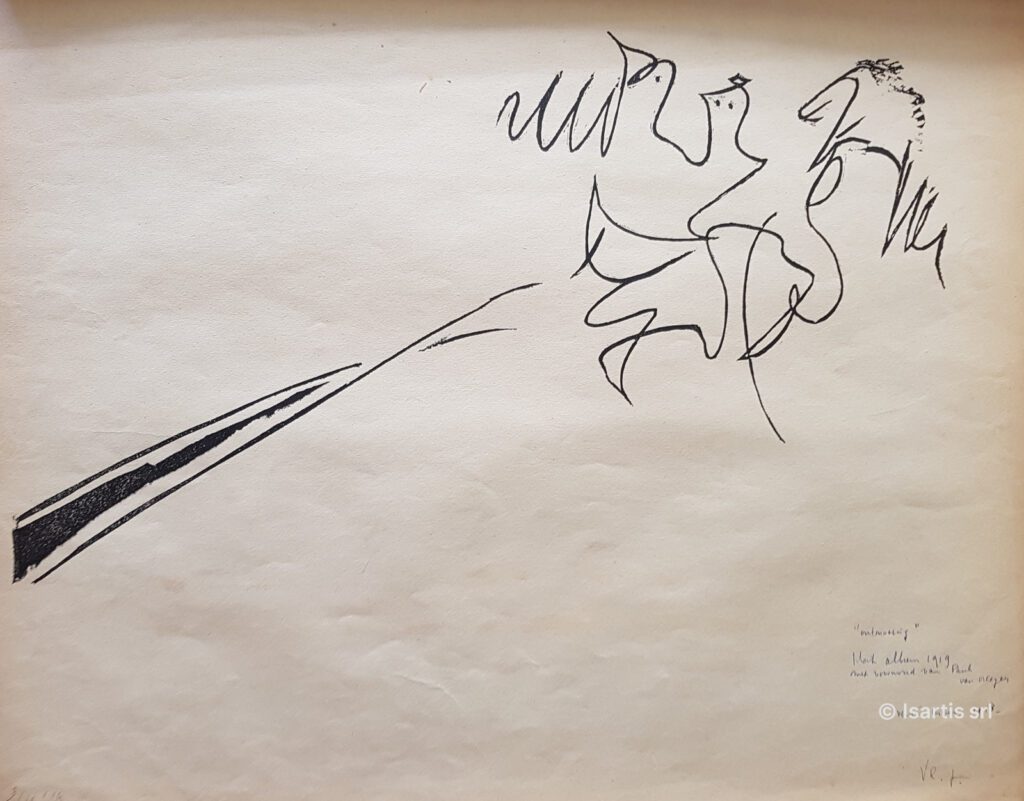
For Jespers, a line was never just a contour; it was pure energy. We see this at its most powerful in his expressionist graphic work. In the linocut 'Encounter' (1919), the line is not a description but an "explosive, futuristic collision". It is a single, unstoppable movement that makes the shock and dynamism of the modern age palpable. In his landscapes, such as 'Farm with Willows', the same line becomes nervous and tormented, giving the trees a soul and the landscape a deep, psychological charge. Jespers doesn't 'draw'; he lets the line fight, dance, and vibrate.
The Alchemy of Glass:
The Unique Reverse Glass Paintings
The technique of reverse glass painting (églomisé) is the ultimate test for an artist: one paints in reverse and the final touch must be applied first. Jespers was a rare master of this demanding craft. With works like 'The Harbour' (1964), he reached a pinnacle. By applying paint and gold leaf to the back of the glass, he created an unprecedented depth and luminosity. He transformed a raw, industrial scene like the petroleum harbour into pure, "glowing poetry". In his hands, glass becomes an alchemical medium that does not represent reality but elevates it into a radiant, precious jewel..
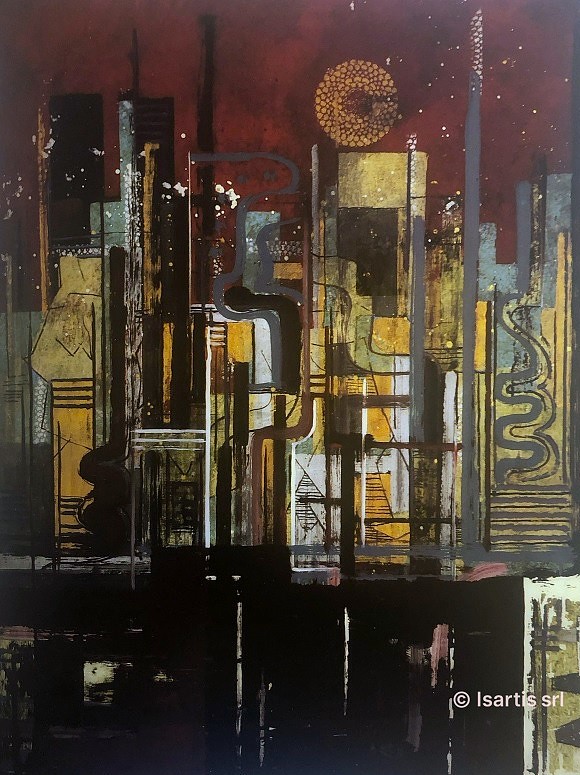
The Architecture of Modernism
As one of the key figures of the modernist avant-garde, Jespers understood that a painting had to be 'built'. Influenced by Cubism, he learned to deconstruct reality and reassemble it into a new, powerful visual logic. In works like 'Double Portrait' (1923), we see how he merges Cubist and Expressionist principles to capture not the exterior, but the the psychological tension between two figures.
This architectural vision—thinking in planes, structures, and compositional lines—remains the hidden backbone of his entire oeuvre, giving even his most fluid works a rock-solid, underlying structure.

Art in Life: Connections and Context
The Pulse of the Avant-Garde: Friendship and Graphic Art
Jespers' art did not emerge in a vacuum, but in the vibrant heart of the Antwerp avant-garde. His friendship with poet Paul van Ostaijen was the "intellectual engine" that fuelled his development. Jespers became a 'house illustrator' for the movement, and his graphic work was the "visual heartbeat of the renewal".
This collection makes that bond tangible in a unique way. It not only contains the publications for which he created illustrations but also a cultural relic: the unique, dedicated manuscript of Van Ostaijen's poem 'Marc groet 's morgens de dingen' (Marc greets the things in the morning), with a personal dedication to Floris' son. For Jespers, art was not a solitary act but a living dialogue.
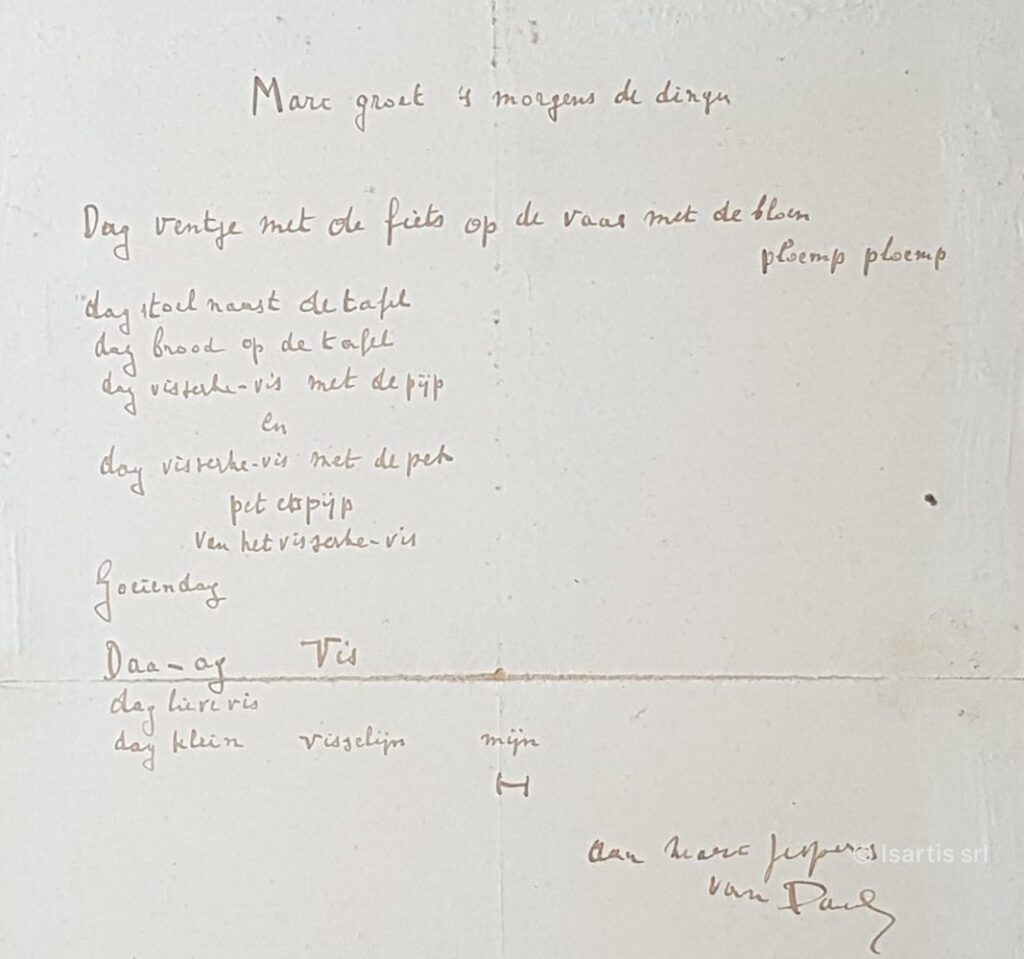
A cultural relic with an intimate secret: the dedication 'To Marc Jespers from Paul' reveals the friendship behind the modernist revolution.
The Resonance of the Cello: Music in the Brushstroke
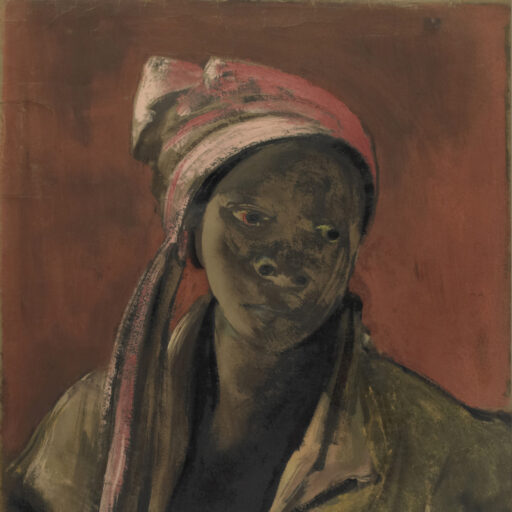
Before becoming a celebrated painter, Floris Jespers was a professional musicianfor years. The baroque cello from 1753, a centerpiece of this collection, was literally the instrument with which he shaped his artistic voice. This deep-rooted connection to music is nowhere more palpable than in his Congolese works. His unique gift for visually capturing the essence of movement and sound was also noted internationally by experts who studied his work in the context of colonial perceptions. Read more about Jespers' work in colonial Congo here.
"One of the few Europeans who truly managed to capture the abstract rhythm of Africa."
Freddie Booker-Carson, curator of the exhibition 'Seeing Africa' (Tate Britain, 2006) and the collection 'The Africanists' (Bonhams, 2009).
The Humanisation of the Universal
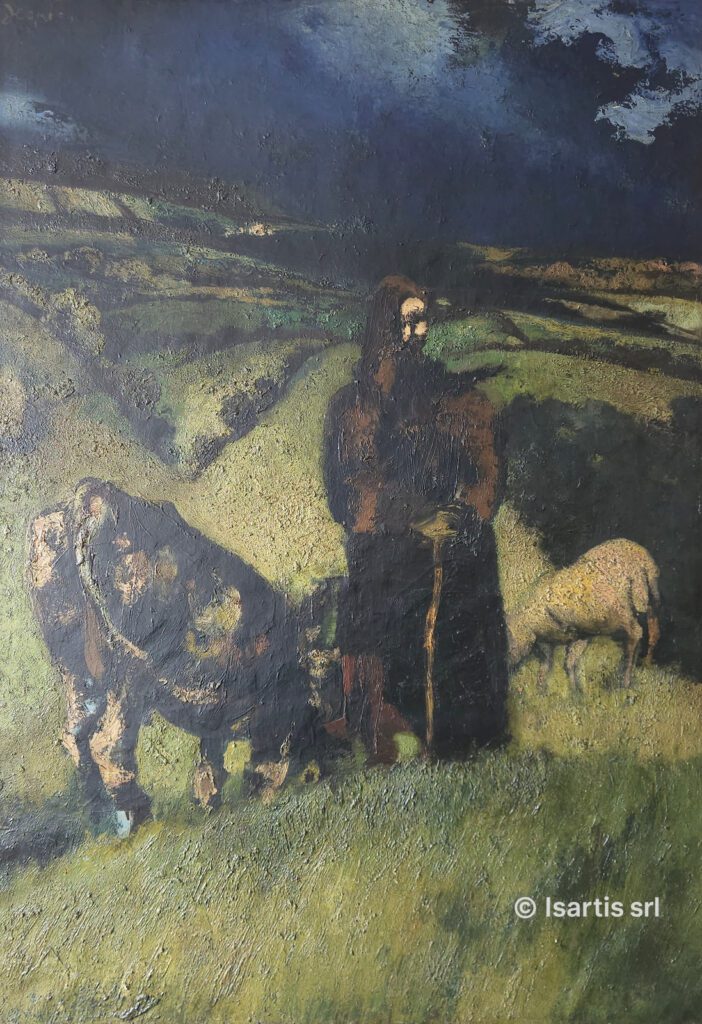
In his mature period, with masterpieces like 'Saint Francis', Jespers demonstrates his unique gift for comprehending and 'grounding'grand, universal themes. He doesn't paint the saint in an idealised, sun-drenched Italy, but places him as a monumental, anonymous monk in the middle of a dark, heavy, and expressive Ardennes landscape. Painted during the war years, this work becomes a deeply felt meditation on perseverance, peace, and hope in the darkest of times.
This method—stripping away the anecdotal to arrive at a spiritual, earthy essence —is a key to his entire oeuvre and shows his search for an art that does not illustrate, but moves.