


Context: A Collection in Dialogue
The Floris Jespers collection is more than an overview of Flemish modernist masterpieces; it is a unique art-historical archive that encompasses entire life story of the artist. Its power lies in the internal coherence that reveals both aesthetic highlights and historical tensions .
On this page, we focus on the most complex chapter — his period in Congo — and invite an open dialogue about art, history, and our changing perspective on the past.
It is precisely this complexity that makes the collection more relevant and socially valuable today than ever: what once may have seemed uncomfortable, now becomes an opportunity for critical reflection and a shared understanding of history.
The Bridge Between Worlds: A Lifelong Quest
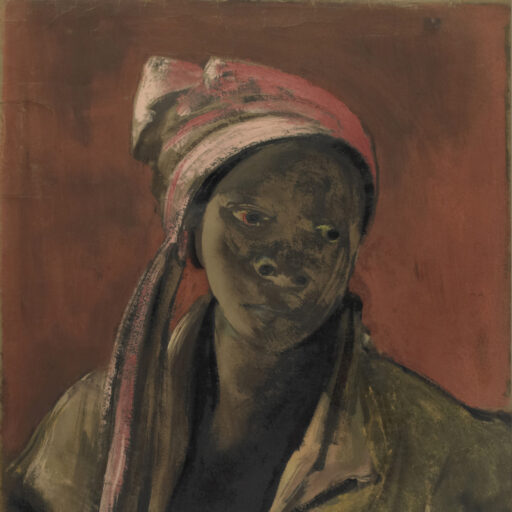
Floris Jespers' celebrated Congolese period (1951-1960) was not a sudden break from his past, but the powerful culmination of a journey that began decades earlier in Flanders. The seed for this was already present in his double-sided childhood drawing from ca. 1895: one side depicts a pastoral, rural scene, the other an airplane — tradition versus modernity on a single sheet.
He revisits this tension in Flemish masterpieces like The Annunciation (1938-1940) and Saint Francis, in which universal stories are anchored in a sober, local reality. His encounter with African culture ultimately offered a new, powerful visual language for that same quest for the 'essential'..
An Artist of His Time: A Complex Bond
Jespers' African oeuvre cannot be seen separately from the historical context of his time, but the path that led him there was complex and personal.
Personal Quest and State Interest
In the late 1940s, his plans to emigrate to South Africa or Argentina testified to a deep desire to leave Belgium. A planned trip to Congo in 1948, made financially possible by the purchase of two artworks by the Belgian State, was at that time a government-facilitated personal dream and not a formal commission.
However, that first trip did not happen. It was only from 1951 onwards, largely due to the presence of his son, a doctor in Congo, that his travels actually took place and led to his artistic"revelation". In his 'Open Letter from Congo', he emphasized that he sought "not the external detail, but the essential, abstract rhythm".
It was only after his influential African oeuvre brought him back into the spotlight and achieved great success that official state involvement took a different form. His monumental work ‘Synthèse du Congo’ for Expo '58 was an explicit commission from the Ministry of Colonies. Here, the relationship shifted: the artist was deployed in the promotional context of a World's Fair that also includedcontroversial ethnographicexhibitions.
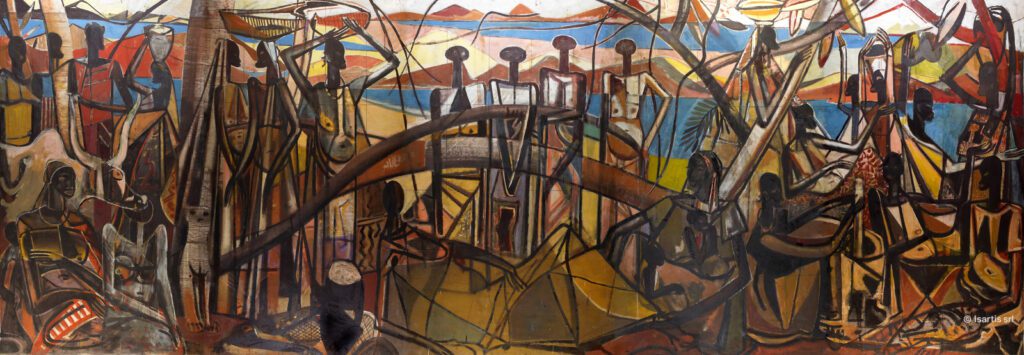
Art historians generally place these images within the Africanist tradition, a European art movement in which an external perspective often prevailed over African voices. However, this label often fails to capture the personal intention behind Jespers' encounter with African people and culture.
Complex Heritage as an Opportunity: A Global Dialogue
It is precisely the layered nature and historical depth that make this collection a rare example of complex heritage: it challenges, and thereby compels a critical, global dialogue.
- A Catalyst for New Knowledge and Debate – The collection contains an exceptionally rich African corpus of more than 130 works, which in itself forms a unique laboratory for the analysis of the European gaze in art. The true power, however, lies in the confrontation of this corpus with the other 770+ works. It is by comparing the Congolese pieces with the Flemish masterpieces that preceded them – such as 'The Annunciation' or his earliest childhood drawing – that researchers can fully understand the evolution of his thinking, the continuity in his search for the 'essential', and the complexities of cultural encounters.
- A Global Mirror & A Unique Opportunity – The assembled corpus — from the childhood drawing to the Congolese climax — offers a mirror for universal themes of art, identity, and history. For any institution, anywhere in the world, it presents a unique opportunity: to bring a complete and coherent European modernist archive into a local dialogue on representation and post-colonial thought from a fresh perspective. Its acquisition would allow for groundbreaking exhibitions, connecting Jespers' respectful vision of African culture with contemporary worldwide conversations.
- Preserving a Unique Archive: A Chance for Stewardship – The fragmentation of this collection would mean the irreversible loss of a unique cultural narrative that is ready for new scholarship. The integral acquisition of this collection is a the global center that, through Jespers' art, connects the specific Belgian modernist context with other cultural art centers worldwide, and to set a precedent in the responsible stewardship of complex, world-class art historical archives.
In this way, a collection of immense historical importance becomes a valuable lever for new insights and global cultural dialogue.
The Full Story
While the historical context is an essential lens for understanding a part of his oeuvre, it forms only one chapter in the full story of one of Flanders' most versatile modernists.
Discover the full scope of his artistry on the pages 'Jespers' Life' and 'Jespers’ Art‘.