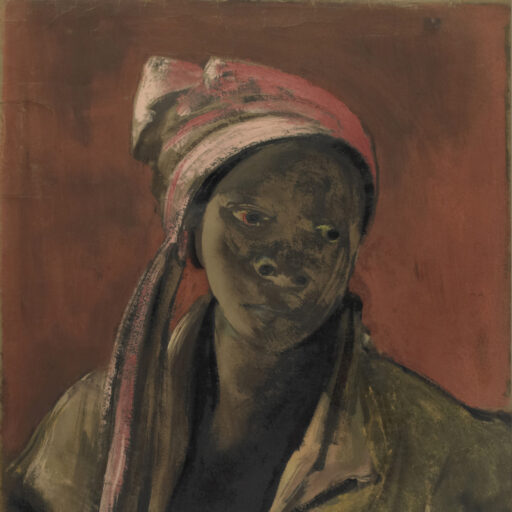



Portrait of Olympe

The Work
- Title: Portrait of Olympe (Floris Jespers' wife)
- Artist: Floris Jespers
- Date: ca. 1916
- Technique: Watercolour on paper
- Dimensions: 91 x 71 cm
In Essence
This vibrant and intimate Portrait of Olympe is a masterpiece of Brabant Fauvism and a crucial starting point in the collection. Made shortly after they met in 1915, it is a rare and tender testimony to a budding love. Stylistically, it forms the colourful departure point from which his entire versatile oeuvre would develop.
A Deeper Look
The Scene: Warmth in Winter
The work shows an intimate and informal portrait of Olympe, captured in a moment of rest and introspection. She sits slightly asymmetrically in the frame, her gaze directed downwards at the muff in her lap. This accessory places the scene in a cold season, which forms a fascinating contrast with the exuberant, warm atmosphere the painting radiates.
The Symbols: A Loving Gaze
The symbolism of this work is direct and emotional. The exuberant, non-naturalistic use of colour and the vibrant light effects symbolise not the external reality, but the inner warmth and the loving gaze of the artist. The muff itself, an object of comfort and protection, enhances the introspective and intimate atmosphere of the portrait.
The Link: The Fauvist Starting Point
This portrait is the seed of one of the central themes in Jespers' work: the woman. Here we see her not yet as a symbol, but in her most personal guise. The fauvist style forms a powerful contrast with his later, more intellectual cubist works an d the sombre, earthy palettes of his deep-expressionist period. The most moving connection is with the "Last drawing". Together, these two works form the bookends of a shared life.
An Acclaimed Masterpiece
A Masterpiece of Brabant Fauvism
This work is considered a textbook example of Jespers' Fauvist period. The style, with its exuberant colours and loose brushwork, clearly shows the influence of his contemporary Rik Wouters, the pioneer of Brabant Fauvism. It marksJespers' mastery within this movement, even before he would venture onto other modernist paths.