


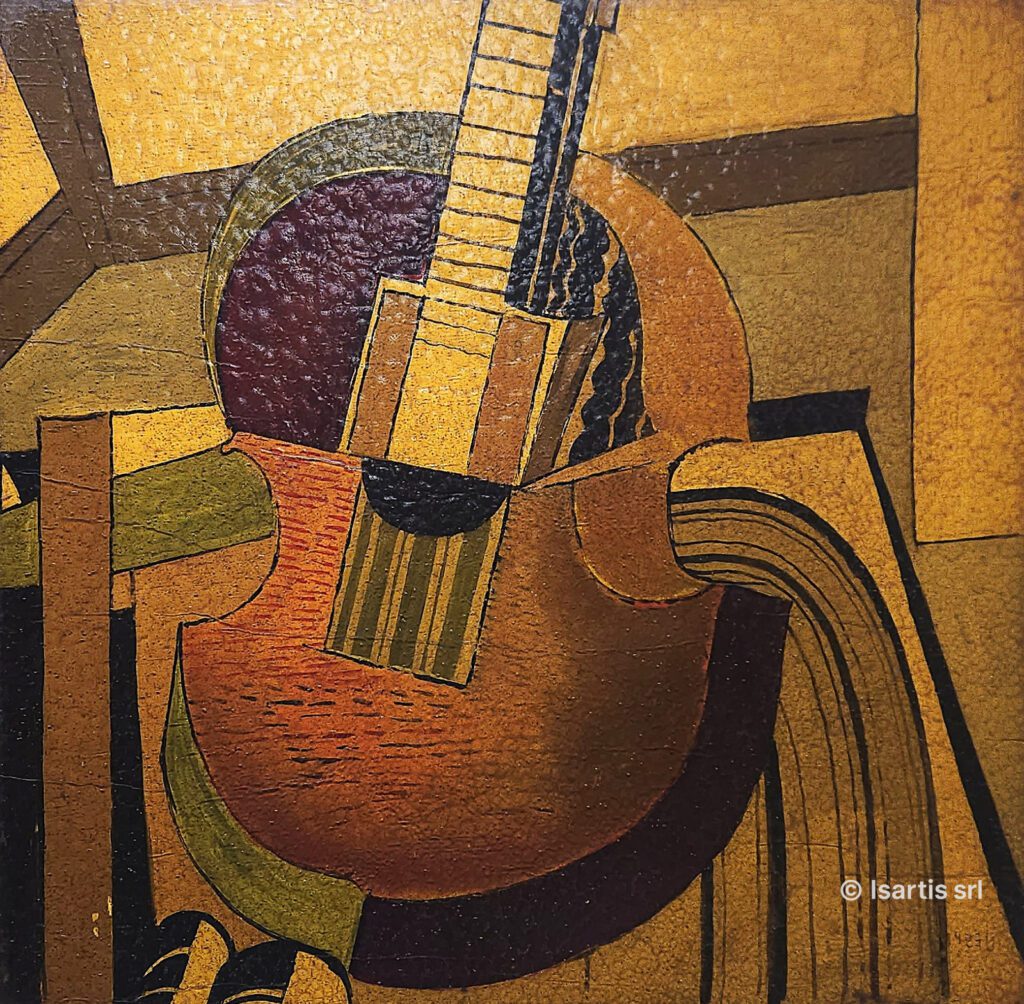
Cubist Cello, early 1920s
The Work
- Title: Cubist Cello
- Artist: Floris Jespers
- Date: Early 1920s
- Technique: Églomisé on cathedral glass
- Dimensions: [Dimensions not available]
In Essence
This technically brilliant églomisé is a masterpiece of Belgian Cubism and one of the most important works from Floris Jespers' modernist period. The depiction of the cello, the artist's personal instrument, elevates this work far above a mere stylistic exercise. It becomes a deeply personal and autobiographical masterpiece that connects the start of his career with its absolute end.
A Deeper Look
The Scene: A Cubist Still Life
The work shows a classic cubist still life, in which a string instrument takes centre stage. The object is deconstructed into a complex and dynamic interplay of overlapping, geometric planes. The background is also fragmented, creating a shallow, architectural space in which the focus is entirely on the formal and intellectual exploration of the object.
The Symbols: An Autobiographical Undertone
By deconstructing the unmistakable form of a cello , this work acquires a personal, autobiographical undertone that most cubist still lifes of his contemporaries lack. The work becomes an intellectual exploration of an object that had a deep personal and musical meaning for the artist. The precious églomisé technique, with its radiant golden tones, elevates this personal study to a jewel-like icon.
The Link: The Echo of the Cellist
The cello is the most significant autobiographical motif in Jespers' oeuvre. This work from the early 1920s is a direct reference to his past as a professional musician. The circle is poignantly completed when this same instrument reappears, forty-five years later, in his "Last drawing". This églomisé and that last drawing together form the musical bookends of his life, giving the collection a rare depth
A Technical and Artistic Masterpiece
An Early, Virtuosic Églomisé
The note that this is a "very early" églomisé is art-historically very significant. It shows Jespers' early mastery of this extremely demanding technique. His choice to combine the most progressive style of his time (the Cubismwith an old, artisanal process is a powerful statement about the synthesis between tradition and modernity..