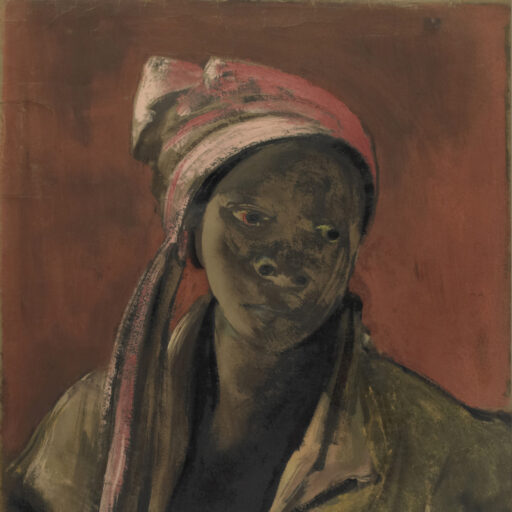



African woman with red headscarf, 1951

The Work
- Title: African woman with red headscarf
- Artist: Floris Jespers
- Date: 1951
- Technique: Oil on paper
- Dimensions: 100 x 75 cm
In Essence
This iconic and fundamental portrait from 1951 is the cornerstone of Floris Jespers' Congolese period . It functions as the crucial bridge between his mature European style and his new African reality. More than a portrait, it is a powerful and deeply felt statement about universal human dignity..
A Deeper Look
The Scene: A Study in Dignity
The painting is a monumental portrait of a woman, depicted bust-length against a neutral background. This choice eliminates all context and places the entire focus on the subject. Her averted, pensive gaze and the dramatic chiaroscuro lighting that shapes her features create an atmosphere of stilled peace, seriousness, and intense psychological depth.
The Symbols: The Human Behind the Image
The symbolism of this work lies in its pure humanity . By depicting the woman with such seriousness and monumentality, Jespers elevates her far above an exotic type, to a universal symbol of a self-aware, human presence. Her introverted gaze symbolises a rich inner world, a soul that the artist approaches with deep respect.
The Link: The Bridge between Continents
This work is a crucial turning point in the collection. Stylistically, it is a direct continuation of his Flemish expressionism from the 1940s, with the dark, earthy colours and sculptural modelling we know from works like "Saint Francis". The subject, however, is radically new. This painting documents the precise moment of encounter between the European painter and the African reality. It forms the humane and psychological basis from which his later, more stylised and collective Congolese works will evolve.
The Cornerstone of the Congo Period
This work is considered the cornerstone of the renowned African period. It is artistically invaluable because it documents the authentic, first artistic 'encounter' . It is the psychological anchor for all the more complex and synthesised works that would follow, and shows the deep, respectful attitude with which Jespers approached his new world.